Research & Writings
Summaries of my academic work, long-form articles, tutorials, and miscellaneous notes. Filterable by topic.
Summaries of my academic work, long-form articles, tutorials, and miscellaneous notes. Filterable by topic.
4 years ago I watched an interview with Sergey Rukshin, who taught math to two future Fields Medal laureates, Grigori Perelman and Stanislav Smirnov, during their high-school years. Given the breathtaking progress in AI, particularly in AI-guided math problem solving and theorem formalization, there’s a general public interest in Fields level research, and once you start looking into the grand challenges of math it’s hard to ignore the only man ever to solve a millennium problem, who adamantly refused to accept the prize for it. Perelman is often mythologized, so I thought it’s worth transcribing and translatingboth done with Gemini 3.1 Pro and light editing the original video interview from Russian to English to increase its reach.
It also had a very profound impact on my attitude to research. At some point, Rukshin notes:
Let’s remember that in Russia, it wasn’t unheard of for an engineer whose bridge collapsed to put a bullet in his temple. This responsibility, if you will, was also part of the culture of the Russian school in a broader sense—engineering education, military education, and so on. It was a part of general education, higher engineering, and military education. It is responsibility for what you do.
It left such a strong impression on me that I didn’t even want to fact check it; even if it was an exaggeration, I preferred to live with that myth. A few years later, I stumbled upon this photo:
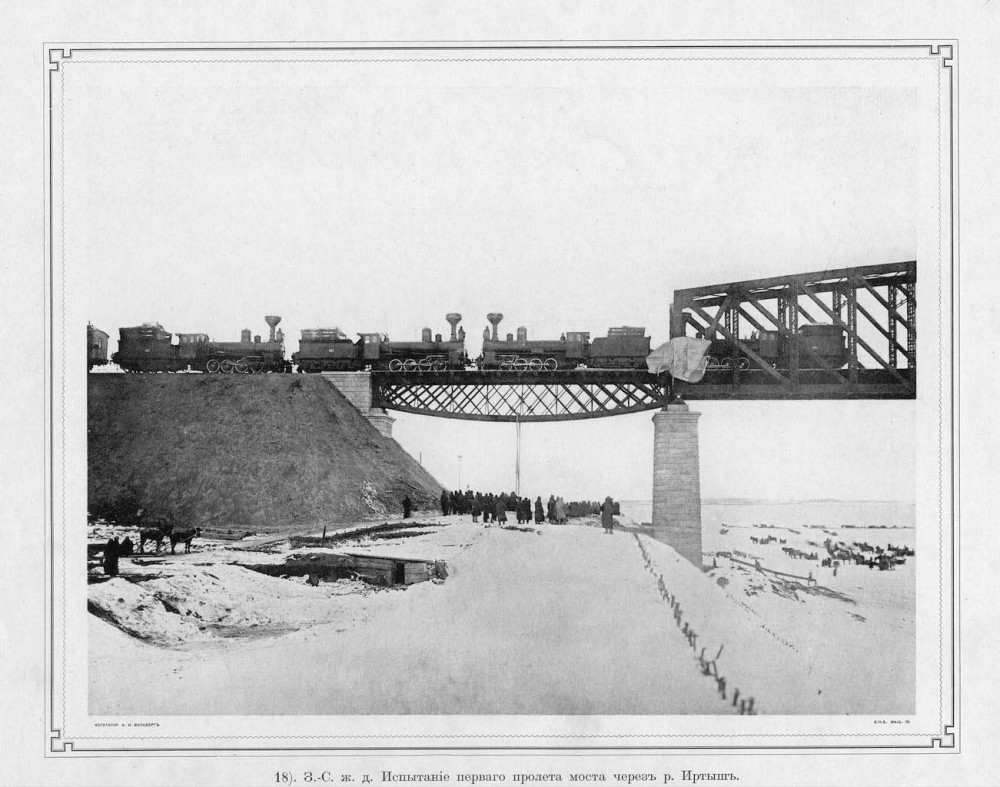
the caption reads “Testing of the span of the first bridge across the Irtysh River”, and the crowd directly under the bridge is supposedly the engineering group responsible for the bridge design. And I think, however harsh it sounds, Rukshin’s phrasing of responsibility is something thatin my absolutely subjective view is mostly absent from the minds of scientists today.
Disclaimer: I am translating and annotating this interview because it’s a historically significant document. The views expressed by Sergey Rukshin are his own. Presenting them does not necessarily constitute endorsement.
Solodnikov: Sergey Evgenievich, you have mentored a huge number of mathematicians, including some outstanding ones. Among them are two Fields Medal laureates, Grigori Perelman and Stanislav Smirnov. Tell me, please, what was it about the education system in which you worked—and about you, of course, as a teacher—that allowed you to raise such young men?
Rukshin: Well, first of all, to be honest, it wasn’t just me. It was also their natural abilities, their upbringing, and so on. The Fields laureates, and my, what is it, four or five Salem Prize winners, and all the rest—they are not products of an educational system alone. They are products of an educational system into which a specific individual arrives, an individual whose family has instilled in them a certain motivation, who may or may not want to work to satisfy their own ambition. As for the system I worked in, well, I’m still working in it. It had several distinctive qualities that the Russian school has traditionally inherited from ancient times. Under socialismduring Soviet times, when I was accused of this, it was a very damning verdict, because I was told that the mathematics center I built was based on capitalist principles.
Solodnikov: They told you that under socialism?
Rukshin: Yes, that it was focused on results. So, let’s be honest: Russia’s educational system, starting at least with the specialists Ivan the Terrible invited to teach our own, then under Peter the Great, and later with the invitations to foreigners in the 1930s, was always aimed at achieving a result. So, the first thing is that within the existing educational system, I managed to build a system that was aimed at the maximum self-realization of each person’s abilities. It was focused on results, not on pseudo-democratic principles that all children or all students are talented and you just need to unlock it, and so on. You’ve probably never noticed that, in a way, the ideal education system was built only once, and even then, only in literature.
Solodnikov: And where was that?
Rukshin: In the first novel of Akunin’s Fandorin series.
Solodnikov: The Winter Queen.
Rukshin: The Winter Queen [Original title: Azazel]. It showed us this supposed educational system built by Lady Astair, in which the individual abilities of each child are identified (admittedly, the system was aimed at orphans, so parents wouldn’t interfere), and he is given an education in accordance with those abilities. And our dear countryman Fandorin destroyed that ideal system. Quite successfully, he managed it, though not right away. But that system is ideal. To discover in each person not that they have abilities, under the pseudo-democratic slogan that everyone is capable, but to discover the abilities that they can realize to the maximum degree for the benefit of humanity—we can’t do that. We haven’t yet invented the methods to do it. Since I limited myself to intellectual abilities—not just mathematics, but theoretical physics, then computer science, then programming.
Rukshin: I just yesterday had the honor of having dinner with Kolya Durov. Pavel’s [Durov’s] older brother. The very same Kolya Durov who, after Pavel’s initial sketches, wrote the massive code for VKontakteVKontakte was the Facebook of the Russian-speaking internet that we all encountered. Because he is a mathematician and a programmer.
Solodnikov: And what was your connection to him before yesterday’s dinner? Were you his teacher?
Rukshin: Nikolai Valeryevich Durov is an absolutely remarkable man. I’m talking about him as a person now. First, he’s unique—he has seven medals from international olympiads: three in mathematics and four in computer science. He studied at our mathematics center with my student, Golovanov, and I prepared Kolya for the international mathematics olympiads. So I’ve simply known him since his early school days.
Solodnikov: Did you work with the younger brother?
Rukshin: No, Pavel is a philologist by education, so to speak. By interest. The fact that he learned to program well enough to write the first version of VKontakte was, let’s say, a bonus. I know the elder Durov because their father was the head of the Department of Classical Philology at the Philology Faculty of our Saint Petersburg State University, and I also had the honor of knowing him; he was a very well-educated man. So, yesterday I was talking with Kolya Durov, who was visiting St. Petersburg for a week, and I must say that the subject of our conversation was not mathematics or programming at all, but rather Romance languages, philology, translations of foreign poetry into Russian, the merits and shortcomings of Marshak’s translations, and so on. As a rule, these people are not one-dimensional, that’s my point. So in reality, their abilities are quite multifaceted. And many of them could have realized their potential fully, brilliantly, and for the benefit of humanity in very many fields.
Solodnikov: Well, may I clarify then? About the two I asked about at the beginning, Smirnov and Perelman.
Rukshin: Yes.
Solodnikov: What kind of person is each of them?
Rukshin: Well, it’s very difficult to characterize a person with a short list of qualities. Of course, if we’re talking about Perelman, we must emphasize the very qualities that drew the attention of the non-scientific public to him. With all those refused prizes, the unclaimed millions… Perelman is a unique product of the Soviet system of education and upbringing. He has always sincerely believed that one must unconditionally tell the truth. He is an exceptionally decent person. In all the many years I’ve known him, since the 5th grade, I can’t not only accuse him but even suspect him of ever telling a lie. As an example—and Grishain Russian most names have a “diminutive” version which might be used among close friends. Grisha is diminutive of Grigory really dislikes it when I tell stories about him… In recent years, journalists have finally worn him down, starting with Malakhov’s TV crewsMalakhov’s show is like TV version of BuzzFeed shoving cameras into his apartment door, with nationwide discussions twice an evening about whether he lives poorly, modestly, or in poverty. So he has a certain moral right to be left alone, but I’ll tell the story anyway. When he was a child, we’re riding the subway after class at the math center, a group of kids from my circle.
Solodnikov: And where was the center located?
Rukshin: At that time, I founded the mathematics center at the Zhdanov Palace of Pioneers in ‘74. Back then, I was a lab assistant, not yet 18, so I couldn’t be responsible for the children’s life and health. But in ‘75, as soon as I turned 18, I became an instructor, not a lab assistant, and it was in the science and technology department of the Palace of Pioneersa government funded community center (science club, arts school, and sports center all in one) where you can sign up to take classes.. Anyway, I lived in Pushkinsmall town part of St. Petersburg metro area at the time. We’re riding the subway—the Kupchino station had just opened—a large group of students. It’s hot in the subway, everyone is sweating. Perelman is wearing a fur hat with a scarf wrapped around it, the hat tied with a bow. And his classmate and fellow student, Boris, says to him: “Grisha, untie your hat, you’re sweating, you must be hot.” He replies: “I promised my mom I wouldn’t untie my hat.” Boris tells him: “Come on, no one will know, no one will see. When we get out of the subway, you can tie it again.” “No, I promised.” Perhaps this smacks of an unconditional, formal adherence to a commitment, rather than its substance…
Solodnikov: Damn, that’s like the story “A Word of Honor.”
Rukshin: Yes, exactly. There you have it, he made a promise. And, I repeat, the Grisha I met back then has not changed a bit. He’s the same today. When his mother was ill, and they might have needed good doctors, good medicine, something else, Grisha seriously considered—and as he said, you have to believe Grisha—he seriously considered whether to accept the prize or not. But he could not bring himself to accept something from the hands of people he considers dishonorable, even in such circumstances. So, without a doubt, the thing to say about Perelman is that he is a man of fanatical integrity.
Solodnikov: Sergey Evgenievich, if I may clarify, why did he… He refused the Fields Medal.
Rukshin: Yes.
Solodnikov: Why?
Rukshin: And not just the Fields Medal, but also the million dollars awarded later, the Clay Institute prize—these are different prizes.
Solodnikov: Why did he… why does he consider these people, these prizes, to be dishonorable?
Rukshin: In the 1990s, after his first long visit to the United States, Grisha and I were talking about his impressions of the mathematical community. He described it something like this: mathematical theorems have turned into a commodity. They can be sold for a profit, they can be bought, they can be stolen. Let’s be honest, the Poincaré conjecture, which he worked on for almost nine years—that’s a little longer than the nine months a woman carries a child in her heart. For nine years, the person doesn’t know if this “child” will be born, if a result will be achieved or not. Every year at the mathematical institute, in his lab, they demand an annual report from him: what he has proven, what papers he has published, what conferences he has spoken at. Incidentally, this is partly why he left his geometry lab, where they would say to him, “Grisha, how are you going to file your reports? You don’t have a single publication, not a single presentation.” So, that’s nine years of work. Can you imagine how much of his soul a person pours into that work, how invested he becomes?
Solodnikov: I can’t even imagine.
Rukshin: Now imagine a mother being offered money to sell her child, to buy her child. Well, mathematical theorems, as he noted back in the 90s, had become a commodity. A typical situation that many mathematicians encountered—even I, who am much more of a mathematician than a teacher—was this: they offer you a grant to come visit them. In the 90s, a grant could be hundreds of times my salary as an associate professor. “Come visit us, we’ll work together for a few months, write a joint paper, and this will be the start of our collaboration.” It’s clear that this creates a material benefit for the person who agrees. It’s clear that in the 90s many went for it, and abroad, many, especially those just starting out, did it to earn money or at least get a visiting position at a prestigious university. A theorem can be stolen because, well, a mathematician raised in Soviet society was usually happy to talk about his successes. It sometimes took several years to get published, especially in prestigious journals. But how could you not share your joy with colleagues about what you’d achieved? “Look how great this is, how wonderful.” Theorems were presented at seminars—at one’s own department, at the mathematical institute, in other cities of the USSR where there were specialists in the field. Everyone did this. But suddenly, it became clear, especially abroad, that you couldn’t live like that. Because if you presented a result at a seminar and someone managed to understand it, they might ask you an innocent question: “Where can I read about this? Is it published?” You’d say, “Not yet, the paper hasn’t come out.” And then a paper comes out under the name of one of your listeners. Let’s note that the exact same thing happened with Perelman’s Poincaré conjecture—well, not entirely, but still…
Solodnikov: The Chinese did something…
Rukshin: Not just the Chinese, the Americans too. Not just Professor Yau’s group, the Chinese… the Americans… Of course, they didn’t immediately understand the rather brief papers he [Grisha] posted to the arXiv. Naturally, they asked him [Grisha] to explain, to clarify, and he spent a long time traveling and explaining his results. After which, two groups of mathematicians, including the Chinese, published not the few dozen pages of Perelman’s work, but 400-500 page books, claiming that they were the ones who had provided the complete proof. Of course, these “listeners” had little to do with proving the Poincaré conjecture, but they claimed they did. And Perelman had a serious grievance with the mathematical community, including the Russian one, because he believes no one stood up for him. These people, because they are influential, like Professor Yau, were not accused of dishonesty. So, there you have it… And then this very same mathematical community, from Grigori’s point of view, encourages the trade and theft of mathematical results through its existing principles. So theorems can be stolen, they can be sold, they can be attributed to someone who has nothing to do with them, all for material gain.
Solodnikov: Sergey Evgenievich, tell me, have you ever allowed yourself… I mean, your heart must be not in its place…Solodnikov uses the idiom “сердце не на месте” which literally means “heart is not in its place” but figuratively means “feeling uneasy/anxious.” Rukshin deflects by taking it literally You must worry about…
Rukshin: My heart is on the left side.
Solodnikov: Well, you worry about his mother, about him… Have you ever tried to talk to him and explain that, well… I don’t know. Well, in a situation where… I don’t even know how to phrase it… Or have you never allowed yourself to do that?
Rukshin: To talk about… what? About compromising his principles?
Solodnikov: No. Well, his mother fell ill, money was needed, maybe for good treatment, and okay, I won’t… I don’t know how… I understand that even by asking you this question, you’ve already answered it.
Rukshin: Unfortunately, every attempt to talk about such topics with Perelman usually led either to a loss of trust…
Solodnikov: I see.
Rukshin: Or… First, it yielded no results. And second, it either led to a loss of trust or, unfortunately, further limited his contact with humanity.
Solodnikov: Right.
Rukshin: Because, I repeat, when some girl, I don’t remember her name, laid flowers at the foot of Grisha’s door for the cameras and shouted (while being filmed, and it was later broadcast): “Grisha, I want to have your baby! He’ll be smart like you and beautiful like me!”
Solodnikov: Idiots.
Rukshin: I repeat: this does not inspire his trust in humanity. And sooner or later, such a multi-year trauma, this harassment, spills over onto people who were once close, once more familiar, and so on. So, of course, I tried at one point. It was when the news first came out that he had proven the Poincaré conjecture, when the Fields Medal was awarded in, let me see, 2006. Back then, offers started coming in, which I was asked to pass on to him—for a good, well-paid job, since he had left the mathematical institute. For a nice apartment, for the opportunity to receive state awards, to head a laboratory, or to do science with a different level of freedom, and so on. The typical answer was: “I have everything I need.” And I repeat, this hasn’t changed in decades.
Solodnikov: I understand.
Rukshin: Besides being a brilliant mathematician… unfortunately, I’m afraid, in the pastrefers to being a brilliant mathematician, i.e. he no longer is a mathematician, because you have to believe Grisha: if he said he stopped doing mathematics, then unfortunately, he probably has. He is not just a brilliant mathematician; he is a very decent, very modest, very unpretentious, and very sincere person.
Solodnikov: Sergey Evgenievich, regarding Smirnov, you asked…
Rukshin: Yes, Stanislav Smirnov.
Solodnikov: Stanislav Konstantinovich, he is, without a doubt, a completely different person. First of all, I must say that both of them possess a remarkable breadth of cultural education. Perelman himself once studied the violin; he is very knowledgeable about classical opera vocals. He is a regular at the Mariinsky Theater and, in recent decades, at the vocal competitions held in St. Petersburg. I can take some pride in having played a part in that, because I used to hold classical music evenings at our summer math schools.
Solodnikov: That’s cool.
Rukshin: And vocal music, in particular. Yes, we tried to fill our camps with elements of a full life. We had music nights, and teachers would hold poetry evenings. Stanislav Smirnov himself, when he was a young teacher, gave his students at the camps a series of lectures on the world’s leading art museums. Of course, back then there were no computers, no screens, no internet, but I remember how he would use art albums to talk about magnificent museums and wonderful artists. So, he is, without a doubt, just like Perelman, a very broadly educated person, and he certainly could have successfully realized his potential in many fields completely different from mathematics. Incidentally, he also comes from a family of rather successful scientific and technical intelligentsia. I might be mistaken, but as I recall, his grandfather, [Konstantin] Rudnev, was an outstanding weapons designer. And he grew up under the strong influence of his wonderful, and I repeat, outstanding designer grandfather. Perelman, on the other hand, comes from, let’s say, a simple background of an electrical engineer and a schoolteacher by education. So, undoubtedly, what unites both Perelman and Smirnov is a readiness to work hard for their ambition. Let’s distinguish between two words that are often confused: “chestolyubie” [честолюбие]—a love of honor, for which a person is willing to work. To become famous not just for anything, not in any old way, not with the fame of Herostratus, but through the results of one’s remarkable work. And “tshcheslavie” [тщеславие], vanity.
Solodnikov: Right.
Rukshin: From the old Russian word for “in vain.” They both, without a doubt, stood out from their peers in the math circle, many of whom were no less naturally gifted. From a certain point on, both of them were notable for their readiness to work. To work for the result they wanted to achieve. As for his current situation, yes, Stanislav Konstantinovich, Stanislav Smirnov, is a much more public figure. Next year, a mathematical congress will be held in St. Petersburg, where, by the way, the next Fields medalists will be announced—that’s where they are announced. And Stanislav Konstantinovich is one of the leading organizers of this congress. So, unlike Perelman, he is a public figure.
A remarkable geometer… well, nowadays one should probably say French… Misha Gromov, Mikhail Gromov, who is also a product of the St. Petersburg math and mechanics faculty, believes that Perelman is undoubtedly (at least he said so in an interview) at fault before humanity for not giving back what was invested in him. Smirnov, on the other hand, through his activities, undoubtedly doesdoes give back. He is one of the organizers of Sirius, the presidential center, where he oversees programs. Just now, for the first time in the world, the International Mathematical Olympiad, which is an annual event, was held for two consecutive years in the same country, in the same city, and even at the same university: the Herzen State Pedagogical University, where I work now after moving from Leningrad State University. So, for the first time in the world, the olympiad was held two years in a row in the same country, city, and even university, and Smirnov was an active participantin its organization. Unquestionably, by taking time away from his own scientific pursuits, Smirnov is giving back to humanity what was invested. He organized a new faculty…
Solodnikov: May I clarify? Before we get too far. You mentioned and quoted that Perelman is not giving back to humanity what was invested in him.
Rukshin: Gromov’s words, yes.
Solodnikov: Yes, Gromov said that. What was invested in him. And do you agree with that idea?
Rukshin: I cannot infringe on Perelman’s right to engage in something or not. As I’ve already said, we can encourage someone to do something if we think it’s necessary, but we have no right to demand it.
Solodnikov: One more question about Smirnov. Can you explain what he received the Fields Medal for?
Rukshin: It’s not at all possible to adequately and clearly explain everything to someone who isn’t a specialist. I remember how one journalist, forgive me, tried to explain what Perelman had proven with the Poincaré conjecture. It was quite amusing. I won’t name the channel or the person.
Solodnikov: It wasn’t me.
Rukshin: Well, it wasn’t you. I wouldn’t even say it was in St. Petersburg. But anyway, some non-specialists explained the rudiments of topology to him. They explained that if you stretch a thin rubber film over an orange, you can then take it off without tearing it, but you can’t do that with a bagel. And this journalist tried to walk into the studio—they stopped him just in time—with an orange, a bagel, and a couple of condoms.
Solodnikov: That’s funny.
Rukshin: It is. Yes, his colleagues told me the story, and I believe it’s true, because that is exactly how some topological concepts are explained—that something can be removed without tearing, and something else cannot. Anyway, he received it for work related to percolation, or seepage. We usually know the word “percolator” from coffee makers, when hot water slowly passes, seeps, through ground coffee. There were a number of works by physicists—I’m not a physicist or even a specialist in the area Stanislav received the prize for—in which there were some constants related to the speed and path length of a particle seeping through certain structures, and so on. There was experimental data, and he built a theoretical model of percolation, of seepage through systems that could then be studied. But this won’t add to anyone’s understanding, and for most people, percolation will remain associated with a percolator and a type of coffee maker.
Solodnikov: Sergey Evgenievich, my heart is troubled… when, well, you yourself said that attempts to make everyone happy are doomed. It doesn’t work that way, for everyone to be smart, for everyone to, I don’t know, show ability in all fields of knowledge, and so on and so forth. Today’s school system, well, in principle, all this wordingin discourse related to the provision of educational… what’s the right word… “the provision of educational services”…
Rukshin: Well, yes, a kind of prostitution based on the transfer of knowledge.
Solodnikov: Something like that.
Rukshin: If we’re talking about “services.”
Solodnikov: Something like that, yes. It’s all so disheartening. If you were to try and formulate it, what is the single greatest threat hanging over the Russian school system today? How would you put it?
Rukshin: The trouble is, I can’t formulate it briefly. We can’t articulate what we want without at least a short historical detour.
Solodnikov: Let’s do it.
Rukshin: The thing is, the Russian school—not the ethnic Russian school, but the school of Russia—was built on, perhaps, three pillars. First, it always met the goals set by the state. It wasn’t a social institution, like in modern America. As one American educator told me, the American school doesn’t provide an education; it’s a place where parents can be sure that while they are at work, their child will be looked after from this time to that time.
Solodnikov: But that’s exactly what we have now!
Rukshin: And… that is precisely the danger. So. Yes, in an American school, a child will most likely try drugs for the first time, if it’s a bad school. In an American school, he will get his first experiences of, let’s say, personal interaction with members of the opposite sex. It is a social institution. He will be in relative safety. But what kind of education he gets there is unimportant. The Russian school, the first pillar, always served the needs of the state. Just like the famous story of the choosing of a religion, how Orthodox Christianity served…
Solodnikov: And you’re not just talking about the Soviet school, you mean the school…
Rukshin: The school of Russia! In general! Yes. From its inception, it served the needs of the state. The Italian architect Aristotle Fioravanti, who built the Orthodox Dormition Cathedral and was an outstanding specialist in fortifications, designed the Kremlin. He taught Russian architects who then built defensive structures. Peter the Great sent his blockheads abroad to study not so they could learn to fence in duels, not so they could learn to dance, but primarily so they could become shipbuilders, sailors, military engineers, and so on. This was an urgent need of the state. Peter the Great founded the Russian Academy of Sciences by inviting foreigners who were supposed to educate and create Russian scientists.
Solodnikov: But at the same time… Sergey Evgenievich.
Rukshin: Scientists who were required by the state. It needed specialists in ores, mining engineers, metallurgists, geographers for expeditions. So, the first thing was meeting the needs of the state. So, the first pillar of the education system, starting with the Slavic Greek Latin Academy, was meeting the need for personnel—whether for the church, or for ambassadorial clerks who knew foreign languages and could conduct negotiations abroad. The Petrine Academy needed a Vitus Bering, who would go on an expedition and carry out surveys of Siberia, the Far East, the Kamchatka expeditions, and so on. These were the needs of the state.
The orientation of education was not towards producing dandies adorned with lacewell-dressed elitists, but on what they could and should do for the state. It’s more like the slogan that Kennedy later used and loved very much. Yes, people went for high salaries, but not for a paradise-like life. Kennedy once said, “Ask not what your country can do for you—ask what you can do for your country.” For good money, we were not shy about inviting specialists who were supposed to do the work the state needed and create a system that would educate similar specialists within our country. But…
Rukshin: The second pillar our education stood on is what is sometimes called the Juche ideology. The North Korean one. It is, after all, a reliance on one’s own strengths. Yes, we used foreign experience. We had Academician Rauschenbach, who worked on the space program, and his name makes it clear he wasn’t a Slav. We had an Italian aircraft designerRobert Bartini. We had an outstanding fortification expert—as I said, the Kremlin and the Dormition Cathedral were built by Aristotle Fioravanti, not by Barma and Postnik. But, I repeat, their task was always to train national cadresspecialists to meet the needs of the state. And this was complemented by the Juche ideology. In the long run, our education was aimed at relying on our own resources. America, as a rich country, can afford the bourgeois luxury of simply buying a needed specialist for a huge amount of money when they don’t have one. And they did buy them. After World War II, they took in Germans, put them in good conditions—specialists in nuclear physics, Wernher von Braun, and so on. We could never afford that, due to what are now fashionably called geopolitical reasons. And the experience with the annexation of Crimea a few years ago showed that there are many things that simply will not be sold to us. That no freedom of trade, no free movement of material goods for money, can guarantee that the state called Russia, in its current situation, is capable of buying what it needs, even if it has the money.
Solodnikov: Sergey Evgenievich, may I clarify? So far, you’ve named two pillars… And it turns out that what constitutes… The Russian school.
Rukshin: No, these are principles…
Solodnikov: These are principles formulated by the state.
Rukshin: First, let’s separate two things.
Solodnikov: Yes.
Rukshin: There is the state… Right. And there is the country. And among my acquaintances, there are quite a few people who clearly distinguish between these concepts. There are people who are supporters of this state but don’t particularly like the country. With its population, with the qualities of that population, from Russian drunkenness to Russian laziness. And there are people who dearly love this country but dislike this state. So, you said that the state formulated it.
Solodnikov: Yes.
Rukshin: Well, let’s note that our state has been different at different times.
Solodnikov: Yes.
Rukshin: And this was formulated throughout all the eras of Rus’historical name for Russia.
Solodnikov: But the examples you gave are… historical stages when the state was headed by people who, with their single voice, determined how one or another direction would develop. You spoke of Peter [the Great], who didn’t need… well, he had advisors, but he was undoubtedly a sole ruler… and Stalin.
Rukshin: Well, first, I want to recall the quote that democracy is the rule of the envious poor. Unfortunately, people who are already well-off… in my memory, they have not created great states. Second, let’s remember something about the demos. Do you remember how many countries exist today with true democracy? In Athens, indeed, all full citizens—and there weren’t that many of them—could gather in the square and vote on an important issue for the state. In our history textbooks, they love to cite the democratic foundations of Slavic states—the Novgorod vechetown hall. How did the Novgorod veche usually end? Well, after the vote…
Solodnikov: I don’t know.
Rukshin: An example of democracy. A wall-to-wall brawl! One side goes against the other. Even on the scale of a more populous Novgorod the Great, democracy didn’t work. You see, there are intelligent people, and there is public opinion. I don’t want to talk about exceptionalism right now, but nevertheless, the highest value of a function—of intellect, of responsibility for what is done—is always greater than the average value. And yet, when we try to talk about democracy, to resolve issues by voting, to make things good for everyone in matters of state policy, it turns out badly. So, how many countries in the world today have direct democracy? The only kind of democracy is when the entire population, I emphasize, discusses and votes on all fundamentally important issues.
Solodnikov: I’ll tell you right away, I don’t know.
Rukshin: Switzerland.
Solodnikov: Really?
Rukshin: Little, tiny Switzerland with its long-standing traditions. Nowhere else is there direct democracy. Everything else, so-called representative democracy, is a parody of democracy. In America, the population elects electors, the electors elect the president, and so on. Have you personally participated many times in resolving city issues: whether to develop a certain park, to cut down…
Solodnikov: Then let me ask you… Sergey Evgenievich, I’ll ask you directly. Let’s imagine a situation… Grigori Perelman, whom we were talking about a while ago. He makes his own decisions now. Whether to leave his apartment or not. Whether to go to work or not. And you yourself said: I would never allow myself to… overstep…
Rukshin: To infringe on his right to choose.
Solodnikov: He has that right to choose. But let’s imagine what would happen—it’s difficult, of course, but…
Rukshin: Are you prepared to grant every driver the right to choose whether to drive on the right or left side of Nevsky Prospekt?
Solodnikov: No, of course not.
Rukshin: Then what’s the question? Any joint activity and life together must be regulated by some rules that make the existence of that group of people possible.
Solodnikov: But could you have endured a trial against Perelman for “social parasitism”?In the Soviet Union, not having a job was literally a crime. The state could put you on trial for being unemployed. Your labor belonged to the collective, and opting out was theft from society I mean, if it were a trial not against the “parasite” Brodskywas sentenced to 5 years of hard labor in northern Russia for essentially being a writer without official state approval (later received Nobel Prize in Literature), but against the “parasite” Perelman, who doesn’t want to participate in the corrupt, dishonest work of a laboratory…
Rukshin: Whether I would have survived that trial or not would depend on the state of my health.
Solodnikov: Of course.
Rukshin: I don’t know. Discussing hypothetical situations is a bad path. I don’t know what he would be tried for, what he would be accused of. Besides, in this day and age, a trial like Brodsky’s would not be legally possible.
Solodnikov: Not now, yes. But in ‘63…
Rukshin: “You don’t choose your times. You live and die in them.”
Solodnikov: Yes, that’s true.
Rukshin: But let’s realize that every person lives in a specific historical era and in specific circumstances. So discussing the proclivities of Ivan the Terrible and figuring out why Totma was in the oprichnina lands—because it was rich in salt, furs, and so on, and the state needed to get money from somewhere for state-building, for purchasing arms, for creating an army, for defense against… and you can list the rest. There are economic laws. A state, just like a person, cannot live without eating, cannot live without defending itself from enemies, if they exist. Let’s remember that in Russia, it wasn’t unheard of for an engineer whose bridge collapsed to put a bullet in his temple. This responsibility, if you will, was also part of the culture of the Russian school in a broader sense—engineering education, military education, and so on. It was a part of general education, higher engineering, and military education. It is responsibility for what you do.
Solodnikov: It’s all so harsh, Sergey Evgenievich. As I listen to you, as a father, damn it, my heart is breaking. You know, I imagine my child—talented, I don’t know yet, or not—who goes to a school for which the state sets tasks: blah-blah-blah-blah, the ones you listed. The second pillar, responsibility, and so on and so forth. I don’t understand where… where in all of this is a person supposed to live their own life? Well… if life isn’t about serving the state…
Rukshin: This is precisely where the third pillar comes in, the one we must fight for. Unlike the British system, which once had the famous “11-plus” exam, when they tried to determine which level of school pupils would go to—limitations, differentiation, who would get into a grammar school with a full education, and so on. Now we have a bunch of apologists for early differentiation. And for giving knowledge that is “useful for life.”
Solodnikov: You mean when they divide them into classes, like a humanities track, a math track…
Rukshin: That’s a whole other story, humanities, math, and specialized education. The foundational principle of the Russian school was always: to teach everyone, everything. I emphasize: to teach everyone, everything, well, and to make sure they learn it. To the level that a specific person, your child, is capable of absorbing it within that system. We didn’t have early social differentiation. Yes, even in tsarist times there were realnye uchilischa [non-classical secondary schools] and gymnasiums. To enter a university, you had to pass an exam in languages after the realnoe uchilische, but I repeat, it was accessible, and many people did it. So. The principle, I repeat: to teach everyone, everything, well, and to make sure they learn it. Today, I know of only one educational system where these principles are still fully implemented, despite all the talk about “these are different children, these are different times.” That is the presidential cadet corps and similar institutions. There, they teach everyone, everything, well, and make sure they learn it.
As for humanities classes and so on, early differentiation according to abilities—this isn’t about abilities. What a child achieves by the fourth grade does not depend on their personality. See, I’m also concerned about your child. It depends on whether the parents discuss the fairy tale they read with him. Do they engage with him, or do they turn on a computer so he can watch cartoons and not bother them? Is there a family tradition of evening tea and discussing how the day went, what worries everyone? This is a social factor that shapes a child. And a material factor. It significantly depends, with the abundance of our paid services, on whether you enroll your child in a private art school or a private music school, a private sports club, and so on. This is differentiation based on material well-being. There is regional differentiation. With all the will in the world, the opportunities to give a child a broad arts education in Uryupinsk are completely different from those in Moscow and St. Petersburg. Not just in the free systems that exist—libraries, art schools, music schools, sports clubs—but also in the choice, because there aren’t as many diverse and good teachers there. So let’s be honest, let’s not be disingenuous, let’s not deceive ourselves or our listeners. Differentiation already exists. Social, based on family cultural traditions, material, and regional. What is happening now with the attempt to limit disciplines is a state crime, and I will now prove it. A few years ago, there was a powerful explosion that took out an entire section of an apartment building, in Perm, if I recall correctly. A gas cylinder exploded. Two idiot welders decided in the freezing cold that they didn’t want to work with a cold cylinder, so they decided to heat it with a blowtorch.
Solodnikov: Damn, cretins.
Rukshin: Indeed. Unfortunately, they weren’t from a vocational school. In Soviet vocational schools, future welders were taught physics. They would have known that as temperature rises, the pressure in a cylinder increases not by a certain amount per degree, but by a certain factor. It grows exponentially. They blew up the building section because these idiots had only completed some short-term welding courses. Should a future welder be taught physics? Let’s ask ourselves that question. Ask the residents of that destroyed building. And there are examples like this in all, I emphasize, all areas of human activity. It’s not just about welders. You cannot teach a person, generally speaking, only what they will need. We love to ask the absolutely idiotic and completely dishonest question: “Why is this in the school curriculum? Where will I ever need this in life?” Well, each generation judges what it will need in life based on its preceding experience. And if we based what is needed only on preceding experience, then, unfortunately, there would be no carved doors and ceilings; we would be sitting in our cave.
Solodnikov: I completely agree with you. It absolutely infuriates me… This is a complaint from the bottom of my heart. For how many years now has it been the case that a teacher, whether in a school, a lyceum, or a college, can’t afford to expel…
Rukshin: A failing student.
Solodnikov: Can’t expel anyone at all.
Rukshin: Or hold them back a year so they can catch up. They can’t afford to. The education system has become dishonest.
Solodnikov: But that’s insane! It’s madness!
Rukshin: That’s not how it was in old Russia.
Solodnikov: You have these genuine morons sitting there who don’t need anything, they don’t want to learn, they don’t want to do anything, and the teacher can’t do a thing with them…
Rukshin: And the teacher has no tool to make them learn.
Solodnikov: Exactly!
Rukshin: Because it’s the state’s fault. But sometimes they understand that. But realizing it when the only option is expulsion is too late.
Solodnikov: The ability to expel someone, the ability to hold them back a year—that might be the only truly effective and honest tool that can motivate a person in any way, if they don’t want to do a damn thing.
Rukshin: But how can that be… What will the electorate say? Unfortunately, this principle of Western democracies—the people must be happy and vote for us—has taken hold…
Rukshin: That’s disingenuous.
Solodnikov: It’s not disingenuous, it’s sabotage!
Rukshin: It harms the state, I completely agree with you. So, regarding… let’s analyze what’s being pushed on us now. “Let’s teach well. But let’s introduce specialized tracks.” When I was in school, I had no plans to go into mathematics. I was planning to go to the Military Medical Academy. Back then, to get into medical school, you had to pass three exams besides Russian language and literature: physics, chemistry, and biology. Because a competent doctor must understand how fluid moves through vessels—and that’s physics. They must know chemistry, the biochemistry of the organism—a most complex section of organic chemistry. And biology—the science of living organisms. How many of those exams do they take for medical school now?
Solodnikov: I don’t know.
Rukshin: Well, it’s not three. And what does that mean… Now, what is our specialized tracking? We have a “chemistry-biology” track in schools. Chemistry and biology. There’s no physics. What kind of doctor are we going to get? And let’s note that modern…
Solodnikov: Even at home, I’m always discussing this with my wife. I say, “Katya, I’m genuinely scared that in 30 years, or even sooner, in 20 years, who the hell is going to treat us all?”
Rukshin: Instructions and standards!
Solodnikov: Instructions and standards.
Rukshin: You’ll press your finger to an infrared sensor, transmit the data somewhere via phone or computer, and they’ll send you instructions. You know, there’s a term, an “Italian strike.”
Solodnikov: Yes.
Rukshin: Working-to-rule. Only a living person, I repeat, one who bears responsibility and is prepared…
Solodnikov: Yes. yes, an Italian strike is a complete disaster.
Rukshin: Yes. Working-to-rule. Only a person… only a person, not a computer and not a set of instructions, can put a bullet in his temple if it turns out he was wrong or caused someone’s death. Our education system does not instill a sense of responsibility.
Solodnikov: And here, Sergey Evgenievich, we come to the question of upbringing in our schools. As a process. Because… I see. You said, “The state sets the tasks.” Right… But how do you cultivate in a person a sense of responsibility for another human being? Those two morons who blew up the apartment building—it’s not just that they didn’t know the physics. It’s worse… they lacked the basic understanding that, damn it, if you don’t know for sure, you don’t do it, because you could kill who knows how many people. They just didn’t give a shit!
Rukshin: You’ve asked a question I want to answer. Unfortunately, I’m… I’m wired poorly. You asked about people in the humanities. I want to return to that, and then to the question that just followed. The thing is, when I was in school, a “humanities person” was someone who knew everything they were taught in their grade, plus had additional, good knowledge of literature or history.
Solodnikov: That’s true, that’s exactly right.
Rukshin: But we’re lying now! We call a humanities person not someone who knows the school curriculum and, on top of that, has notable additional achievements in the humanities.
Solodnikov: No, nowadays if you don’t know a damn thing, you’re a humanities person.
Rukshin: Now, a “humanities person” is someone who doesn’t know math, physics, chemistry, or something else. It’s a distortion!
Solodnikov: Damn, that’s it!
Rukshin: You’ve just asked a question that is of the utmost importance to me, regarding the education system. We see the same kind of re-labeling in other areas as well. Just as I said, our education system and those who build it lack a sense of responsibility for themselves and the country. Their activities within the education system are guided by their own immediate, personal interests.
Solodnikov: Okay, but I still want to return, Sergey Evgenievich, to the issue of upbringing in school. This also concerns the tools a teacher has to influence the process in some way. How do we imagine a situation that could be reversed? On one hand, you have parents who have gotten a taste of this power to influence the educational process. “Why are you making my child do this or that?”, “You’re not speaking to him correctly,” and so on. How can you take that right away from these parents, the right to interfere in the process, and should it be taken away?
Rukshin: It must be.
Solodnikov: But how?
Rukshin: Through legislation. The law on education needs to be changed. Do not promote a person to the next grade if they haven’t mastered the curriculum of the previous one. Everyone should get what they have earned. And what we are doing now is, by and large, theft—not of material goods, but of intellectual and moral values. It’s theft from the individual, who receives something he is not entitled to. And it’s theft from society as a whole, which will get this person as a full-fledged and respected member who, in other areas, will demand that he receive the same as others, while minimizing his effort and arguing that he’s no worse than anyone else. By changing the law on education, for example—by giving failing grades, by holding students back a year, or by offering different educational tracks. If you can’t or don’t want to master mathematics, you can’t be an economist, because a person who can’t do arithmetic can’t manage a budget.
Solodnikov: But on the other hand, are you ready to grant such authority to the teachers who have graduated from pedagogical universities in recent…
Rukshin: The current ones?
Solodnikov: The current ones, yes. Parents will say, “Look at these teachers, for crying out loud! What can you trust them with?”
Rukshin: They should look in the mirror.
Solodnikov: That’s also true.
Rukshin: These parents… we have raised a generation of people who absolutely cannot be trusted in this matter. It’s much easier to point at others and list their imperfections than to think about what you are like yourself and what all this portends for society. Yes, let them say “for crying out loud,” but there is no other way for society to survive. There is a wonderful old Russian saying, I don’t remember which historian I read it from: “Блядию не проживешь” [“blyadiyu ne prozhivyosh”]. In old Russian, that word meant “a lie, a falsehood, and so on.”
Solodnikov: “Blyadiyu?”
Rukshin: “Blyadiyu.” That’s what it was. Meaning, by falsehood. By lies. It’s a great phrase, you can cut it from the broadcast, but nevertheless, the word had that meaning. Yes, in any specific situation, you can get by with a lie. You understood from the context that it’s a rather old quote.
Solodnikov: So we’re saying we need to give teachers tools. But the most important tool for a teacher is the ability to determine, at least to some extent, how to work with their subject. How to work with their class. Why the hell, then, do they start dictating which textbooks can be used and which can’t? Why, on one hand, have they taken away the tool to either punish or teach a student, and on the other hand, now they’re taking away the ability to choose one’s own methods and textbooks?
Rukshin: Well, formally they haven’t taken away the methodology, but first of all, you can only punish someone who has voluntarily signed up for something. If you went into the 9th grade and declared that you want to study, but then you don’t, you can be punished. But when you have a law on universal secondary education, you didn’t choose anything yourself. It was chosen for you that you will receive a diploma, because education is universal and secondary. So, I repeat, it’s a matter of state policy and a state lie. The lie about the quality of education is the lie of the existing law on education. As for tools, one of the main tools is the social status of the teacher. Let’s recall a work by Vasil Bykov, I don’t remember which one, where he said that before the war, a smart child was told, “When you grow up, you’ll become a teacher.” I remember very well, back in ‘92, I met an American educator in Moscow who had come for an international olympiad. The Soviet Union was formally gone, and Russia hadn’t quite formed yet, but the country was hosting it. And he was discussing what an American parent thinks. “Well, it would be better, of course, if he went to law school or became a politician. Good, clean work, respected. But if the child doesn’t want law school, maybe medicine. It’s good if he becomes a psychologist, a psychiatrist, or a dentist. They get paid well. If he can’t get in there, he could be a surgeon; surgeons are paid well. But if it’s neither of those, and God forbid he’s interested in philology, mathematics, or physics… well, he’ll be a pauper.” That was the social status he presented to me.
Solodnikov: But it’s the same here now.
Rukshin: Money, convenience, and comfort. Yes, exactly. You ask if we can trust the current teachers. But can we trust the current parents? Can we trust the current administrators of the education system? Let’s note that when you have no personnel, you have to nurture and train them, just like children. And this is not an instantaneous process. We have been corrupting them and society for so many years, or decades, that we now need to train and create new personnel. Just like the education system itself. You cannot build long-term success on a lie. A lie has short legs and is for the short term. We must first learn to tell ourselves the truth, including the unpleasant truth, about the state of our affairs, the state of our education system, the state of our industry. How much we depend in metallurgy and other areas on what we inherited from the previous, much-maligned country, and what we have added to it. We must set a clear goal. People must understand what they are working for. For you to want to give your children an education, you must believe that a good education guarantees them success in life. But now, forgive me, the saying goes that… to earn very little [wages], you have to study well and a lot.
Solodnikov: That question… which a person must ask themselves at some point. But it seems to me, how wonderful it would be if your first teacher, or a teacher in high school, were to ask you: “Why do you, as a person, live? What do people live for? For what reason?”
Rukshin: As they say in the wonderful film Formula of Love, “It depends where.” If it’s in our region, it’s for one thing. If it’s in the Kostroma region, it’s for another.
Solodnikov: A person graduates from school now…
Rukshin: It’s a matter of state policy.
Solodnikov: He doesn’t know a damn thing… no one has even posed the question to him. What is stopping a teacher today, if he is a Teacher with a capital T, from setting this kind of vector? After all, despite everything, there is still a certain number of absolutely outstanding teachers.
Rukshin: And there are wonderfully outstanding schools. There are. In small towns too. And in big cities. And in Moscow, there’s the famous “Second School” lyceum, which Ovchinnikov founded… I think the great Ovchinnikov died last year at the age of 90.
Solodnikov: But wait, your lyceum, 239, it’s recognized as the best every year, isn’t it, in St. Petersburg?
Rukshin: Well, what does “the best” mean?
Solodnikov: Well, some ranking, people say…
Rukshin: Er… it was the best school in the country several times in a row. The question is, by what criteria?
Solodnikov: That’s right, the best school in the country, for several years in a row.
Rukshin: The question is, by what criteria. And so on. But I’m talking about something else. The great founder of the “Second School” lyceum, Ovchinnikov, who was its director until he was 90, once answered in an interview what it takes to create a good school. He said, just two things: first, find good teachers, and second, don’t interfere with their work. The journalist then asked, “And which is harder?” First the first, then the second.
Solodnikov: Yes. But at the same time, this teacher and these students need to feel that they are not living in a world that is hostile to them, but in a world that is at least somewhat on the same wavelength.
Rukshin: Well, yes, Gianni Rodari wrote about this in The Adventures of Cipollino, there’s a great quote…
Solodnikov: Which one?
Rukshin: “Lord, save me from my friends; I can handle my enemies myself.” The “friends” who “help” the teacher work are the ones who overload him with reports, determine his salary, create a law on education in which the teacher is obliged to issue a diploma to everyone. Not to teach, but to issue a diploma. And so on and so forth. We have so many “friends” of education who wrote the law on education, who write standard after standard… Recently, my brilliant student and the wonderful director of the Presidential Lyceum No. 239, Maxim Pratusevich, gave an interview where the headline was: “A teacher won’t feel any warmer or colder from reading the Federal State Educational Standard.” A teacher should be teaching children, not writing reports or worrying that students or parents will complain about him. Teaching, in the best sense, is a mission.
Solodnikov: Absolutely.
Rukshin: A personal mission and a mission on the scale of the country and the state, one that determines the fate of the country and the state. He is a missionary. Yes, not everyone is meant to carry this mission, like Jesus, all the way to crucifixion.
Solodnikov: I don’t know. I think that… for all these years, we’ve been endlessly engaged in rebuilding the army. We rebuilt it. Respect for officers…
Rukshin: Well, officers’ salaries have returned.
Solodnikov: …has returned. Damn it, why can’t we do the same with teachers?
Rukshin: And how many teachers do we have?
Solodnikov: I don’t know.
Rukshin: A lot.
Solodnikov: A hell of a lot, yes. Ah, so first you have to downsize them, like the army, and then nurture them?
Rukshin: Well, for the children of the rich, unfortunately, they will study in person. Just like during remote learningduring COVID, many people paid, hired tutors, and their children were taught in person, sometimes at home. And for the rest, as they say, it’s like selling sbitenone of the oldest Slavic drinks, non-alcoholic version made of water, honey, and spices, with the optional addition of wine, mead, or other alcohol in the public squares…
You know, there was a wonderful mistake I made in my life. When I was in school and read Ostrovsky’s plays, I thought, “Well, all these merchants, all this… it could never happen again!” Only later did I realize that for this country, Ostrovsky is not just for the 19th century—he’s forever. In his play Enough Stupidity in Every Wise Man, there is General Krutitsky’s wonderful treatise: “On the Harm of Reforms in General.” For the upper classes, roughly speaking, you stage tragedies to educate them. And for the common people, you “allow the sale of sbiten in the squares.” And so we sell this sbiten in electronic form, cheap junk food at concerts with completely soulless music. We are selling not to the demos—the demos are the part of the population with civil rights—we are selling to the ochlos, the mob, the feeling of happiness for a short time. We sell positive emotions. We have created a cult in which a person must continuously rejoice that he is well, that he can buy this or that, shopaholism… shopaholism is part of this cult. We create positive emotions that are in no way connected to the subject’s awareness of his role as a citizen of this state.
Rights and obligations exist only in unity. Our teacher has many obligations and is becoming almost completely devoid of rights. Parents have many rights in relation to the school, education, and upbringing of their children, but very few obligations. Well, perhaps beating a child and throwing him out of a window is still forbidden. Therefore, we must raise everyone you mentioned—teachers, parents, children—with an awareness of the unity of rights and responsibilities. For the sake of the long-term, historical perspective of our survival. But instead, I repeat, we periodically produce “humanities people” who are not people who know something well, but people who don’t know something at all. We periodically give the right to feel like a confident and worthy citizen to a person who is, in essence, a thief, because a high school diploma for someone who passed the basic-level Unified State Exam…
Solodnikov: (sighs)
Rukshin: …what is that? A good fourth or fifth grader can pass the basic-level USE. And this is a person who receives a diploma for the eleventh grade. In a society of lies, a country with such an education system will, unfortunately, have no long-term historical perspective. And right now, the system of secondary, higher, and further education is in most urgent need of repair and restoration. This is not an instantaneous process. No matter how much I am an opponent of the USE, it cannot be abolished overnight. It must be a long, painstaking process. But it must begin with us stopping, looking around, and analyzing the actual and social consequences of what has happened. The results of the education system reforms that have been going from bad to worse for 20 years. Yes, it had its flaws. We need to define the fundamental core of education. There is such a term, which was used during the education reform in the sixties: to define the fundamental core. A fundamental core—with the honesty of Grisha Perelman. What everyone must know if they have a high school diploma. And teach it to everyone. We must stop asking ourselves the dishonest question that calls us back to the cave: “Where will I ever need this in life?” We don’t know where a doctor will need knowledge of biochemistry in 20 years. But he must have a grasp of the fundamentals of that science, because in his future profession, 10 years from now, he might need it. We must think about the future. And that future must, in the process of education, teach a person, first, fundamental knowledge (the fundamental core, what everyone really must know), and teach them how to think and how to acquire new knowledge.
Solodnikov: And to conclude, Sergey Evgenievich, I’ll tell you something. I was thinking… Recently, I sent a short clip to some friends. It shows four people sitting at a table… Senkevich, Kapitsa, Drozdov, and one other person. And Kapitsa is telling Senkevich—they’re talking about how this is either the late 80s or early 90s… how the country was swept by an epidemic of prison jargon, or fenya. The language of the prison camps.
Rukshin: Yes, well, in songs and so on…
Solodnikov: And they’re saying it’s a catastrophe. A catastrophe. And Kapitsa says, “You know, I was recently at a meeting of some council on culture, or science, or something. And the writer Astafyev spoke, and he said that the dominance of this… this prison lexicon is… First, it must be limited by the efforts of the state, because it is a threat to the national culture.” And then Kapitsa corrects himself. He says, “This is not about censorship. This is about preserving culture. This is about preserving the culture.” And in this sense, I catch myself thinking, damn, we ourselves are in this free space, broadcasting… but when I listen to all this stuff my kids listen to… I tell myself too: “Kolya, this isn’t censorship! It’s the preservation of national culture!” And you now…
Rukshin: Moreover, you periodically insert the word “блин” [blin, “damn”/“heck”], which, as is known, is a euphemism. And you absorbed that during that very same time.
Solodnikov: Unfortunately, yes. Yes! And I am a victim… I am already a victim of this catastrophe that has occurred. We are victims! And our task is to prevent more victims.
Rukshin: I completely agree with you.
Solodnikov: Thank you, Sergey Evgenievich.
Deriving the necessity of eternal punishment from the Prisoner's Dilemma. How infinite repeated games, discount factors, and the Folk Theorem explain the structural utility of Hell in fostering human cooperation
Cursor is dying because cost-optimization forces models into tunnel vision. RAG agents fail because they only see what they search for. The superior workflow for 2026 is massive context windows (gemini 2.5 pro) and manual control. Stop letting agents hide code from the model.
A breakdown of Procrustean Bed for AI-Driven Retrosynthesis: A Unified Framework for Reproducible Evaluation
a deep dive into how the metrics for ai chemical synthesis are broken, rewarding models for "solving" routes with impossible, hallucinatory chemistry. we present the data and the open-source tools to fix it.
science is infrastructure-constrained, not ideas-constrained. an argument on why better tooling, not smarter models, is the missing link in the AI for Science revolution.